
Press a button, place a cup under the spout and wait for your favourite drink. Using a coffee machine can feel wonderfully simple. Behind that everyday routine, however, are clever engineering decisions, more than a century of development and a few details that are easy to overlook.
Why can a machine with a 15-bar pump brew espresso at a different pressure? What causes the pause before the coffee starts flowing? And why doesn’t descaling replace regular cleaning? These ten facts offer a closer look at the appliance behind your daily cup.
1. Espresso history began long before coffee machines reached home kitchens
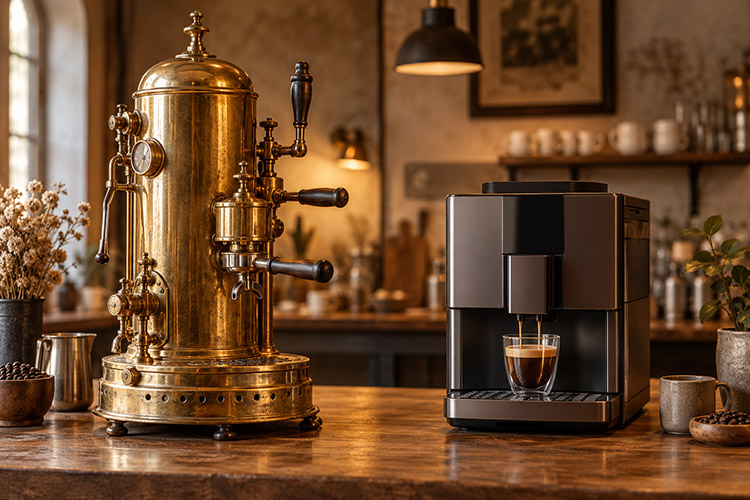
A kitchen espresso machine feels like a modern convenience, but major developments in espresso technology date back to the early twentieth century. In 1901, Luigi Bezzera patented his coffee machine design. Early machines looked and worked very differently from today’s appliances, with large metal bodies and steam-based operation suited to cafés.
The contemporary home machine is the result of a long evolution in heating, pressure control and water delivery. There is a historical connection between those early machines and today’s compact automatics, although their drinks should not be treated as identical.
2. Espresso crema has an engineering history of its own
The golden layer on an espresso is so familiar that it can seem inseparable from the drink. Yet its history is closely connected to changes in brewing technology. In 1938, Achille Gaggia patented a mechanism that marked an important step towards Italian espresso with natural crema. A patent for a lever-piston mechanism followed in 1947.
The appearance of espresso therefore tells part of an engineering story. Still, crema thickness alone is not a complete way to judge a cup: aroma, flavour and finish deserve attention too.
3. A “15-bar” label does not necessarily describe brewing pressure
The number on the packaging often refers to the pump’s capabilities. Pressure during extraction is a separate characteristic, influenced by the machine’s design and brewing conditions.
For example, Breville specifies a 15-bar pump and 9-bar extraction for several of its espresso machines. Those figures are compatible: the pump provides pressure capacity, while the machine regulates brewing conditions.
That is why “19 bar versus 15 bar” tells you little about the flavour in your cup. Temperature control, brewing design and useful adjustments provide a more informative comparison. A larger number alone does not make an appliance professional-grade.
4. A pause before brewing can be part of the recipe
Some machines introduce a little water, pause briefly and then proceed with the main extraction. This stage is known as pre-infusion.
Its purpose is to wet the coffee puck before the main flow of water. In the Breville Infuser, for instance, the initial stage uses low pressure before the machine moves to higher pressure.
A short pause after you start a drink therefore does not necessarily indicate a fault. The machine may simply be carrying out a programmed brewing step. Whether pre-infusion is available, and how long it lasts, depends on the model.
5. A capsule machine can read information from a capsule
A capsule can carry more than a serving of ground coffee: it can also provide brewing information. Nespresso Vertuo machines read a barcode to select extraction parameters. The capsule rotates during preparation, using Centrifusion technology to combine brewing with centrifugal force.
This differs from Nespresso Original, which uses high-pressure extraction. Original and Vertuo capsules are not interchangeable.
The practical lesson is to choose your capsule system before choosing your appliance. Even capsules sold under the same brand may be designed for entirely different machines.
6. A grind adjustment may take a few drinks to show its full effect
It is tempting to turn the grinder dial and judge the very next cup. With an automatic coffee machine, however, a new setting may not be fully reflected in that first drink.
Philips, for example, advises brewing two or three cups before assessing the difference after a grind adjustment. For the relevant models, it also states that adjustments should be made while the grinder is running.
Adjustment procedures differ between appliances, so follow the instructions for your own machine. Change one setting at a time and allow the number of drinks recommended by the manufacturer before judging the result. This makes it easier to identify what actually changed the flavour.
7. Two boilers can let you brew espresso and steam milk at the same time
Espresso brewing and milk steaming require different temperature conditions. Some single-boiler machines need to switch between modes, creating a wait. A dual-boiler design separates the jobs: one boiler handles brewing while the other supplies steam.
The Breville Dual Boiler, for example, supports simultaneous extraction and steaming. This can be useful when preparing several milk drinks in succession.
Two boilers are not a requirement for a good cappuccino, though. They mainly change the workflow. Other heating designs can also offer convenient operation, so check the capabilities of the individual machine.
8. Descaling and removing coffee oils are separate jobs
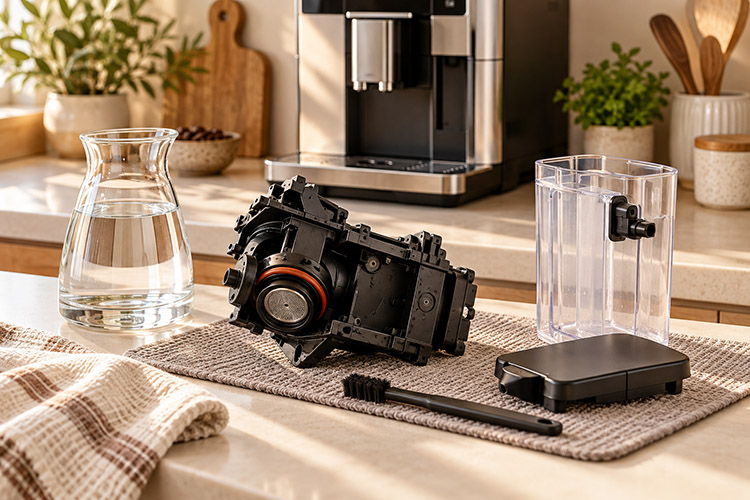
Coffee machines encounter different types of buildup. Mineral deposits accumulate in the water circuit, while coffee residue and oils collect on components involved in brewing.
Consequently, a descaling cycle does not replace cleaning to remove coffee oils. The milk system also needs its own maintenance. Manufacturers provide different products and programmes for these tasks.
Think of maintenance as three areas: the water circuit, the coffee circuit and the milk circuit. Follow your manual’s cleaning methods and schedule, rather than assuming that one cleaning product is suitable for every component.
9. Built-in grinders may not accept beans treated with additives
Sugar-coated beans or beans treated with additives after roasting may sound like an easy route to a dessert-style drink. A built-in grinder, however, may not be designed to handle them.
JURA, for example, warns that its grinders are unsuitable for beans treated with additives such as sugar during or after roasting.
Check your manufacturer’s restrictions before filling the hopper with an unfamiliar product. If you want a vanilla or caramel flavour, a straightforward alternative is to brew suitable coffee and add syrup directly to the cup.
10. Automatic preparation does not eliminate daily maintenance
Automating the drink and automating its cleanup are different things. A machine may rinse itself and display cleaning reminders, while still leaving everyday tasks to its owner.
For several models, JURA recommends emptying the grounds container and drip tray daily. Preparing milk drinks also means following the appliance’s milk-system cleaning routine.
These jobs can become a short evening habit: discard the grounds, empty and rinse the tray, and clean the milk components as instructed. A manageable routine helps preserve the convenience that makes an automatic machine appealing in the first place.
What these facts mean when choosing a coffee machine
Understanding the technology helps you ask better questions. Instead of comparing pump pressure alone, find out how extraction is controlled. For a capsule machine, check capsule compatibility. If you frequently make cappuccinos, investigate the steaming workflow and milk-system cleaning requirements.
A good coffee machine fits both your favourite drink and your everyday routine. When brewing and maintenance make sense, there is more room to enjoy the cup itself.
