
One espresso machine has a portafilter you fill with ground coffee. Another takes whole beans and prepares the coffee after you select a drink. The obvious difference is how much work you do, but that is only part of the decision.
Your choice also affects how you adjust flavour, make cappuccino, clean the equipment and budget for accessories. Both types can make enjoyable coffee. What matters is which workflow suits your everyday routine.
What is a semi-automatic espresso machine?
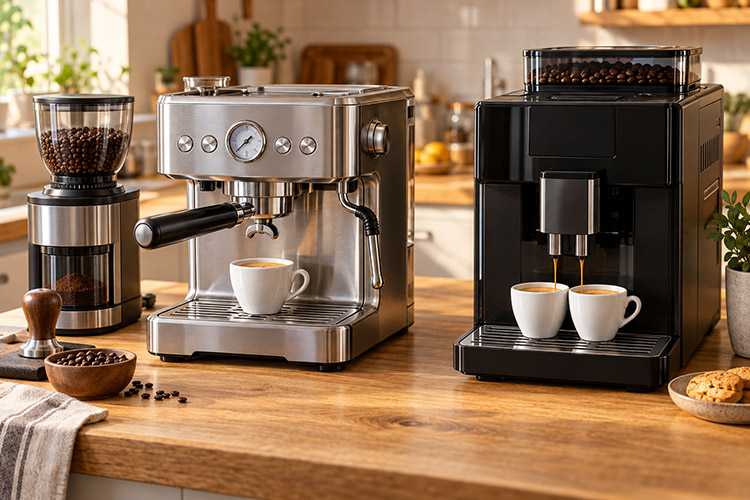
A portafilter espresso machine pushes hot water under pressure through ground coffee held in a filter basket. The basket sits inside a handled holder called a portafilter.
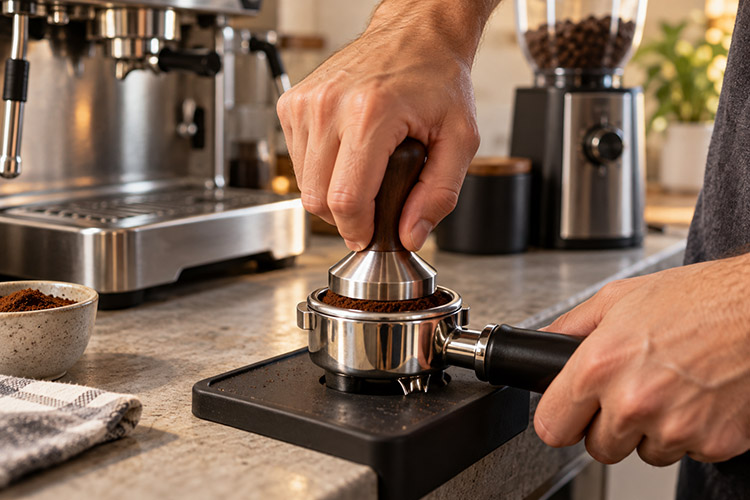
Typically, you measure the coffee, distribute it in the basket, tamp it and lock the portafilter into the machine. Afterwards, you remove the used puck and clean the basket.
Machines in this category can still automate several tasks. Some stop the shot at a programmed volume, offer temperature control or include a grinder. Others assist with dosing or tamping. An integrated grinder does not, by itself, turn a portafilter machine into a fully automatic bean-to-cup machine.
Terminology can be confusing. Retailers sometimes use “automatic espresso machine” for a portafilter model that stops brewing automatically. Check the actual workflow rather than relying on the category name.
What is a fully automatic espresso machine?
Here, “fully automatic” means a bean-to-cup or super-automatic espresso machine with an internal brewing mechanism.
After you select a coffee, it grinds the beans, doses the grounds, forms the puck and brews the drink. The used grounds are then moved into a waste container.
You still refill the water and beans, empty the waste container and drip tray, adjust recipes and carry out maintenance. Automation reduces the work involved in each cup; it does not remove the need for cleaning.
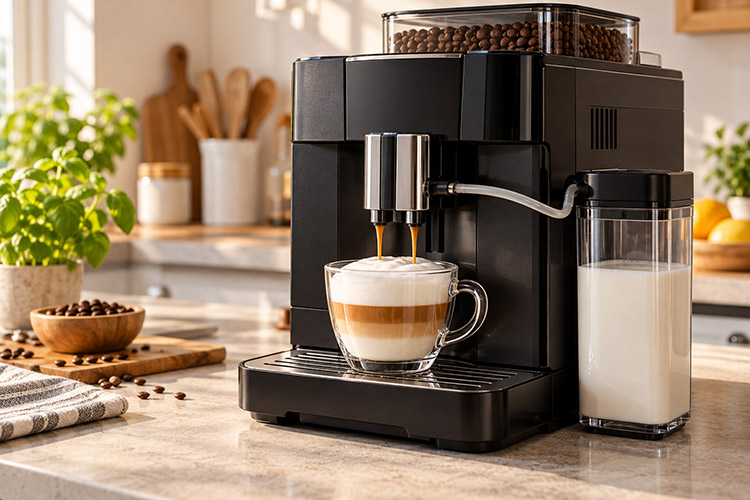
Milk preparation is a separate feature. Some fully automatic machines make cappuccino at the touch of a button. Others brew coffee automatically but use a manual steam wand for milk.
Key differences at a glance
Feature | Semi-automatic portafilter machine | Fully automatic bean-to-cup machine |
Coffee preparation | Usually handled by the user | Handled internally |
Grinding | Separate or integrated grinder; pre-ground coffee may be used | Built-in grinder; some models have a pre-ground coffee chute |
Flavour adjustments | Direct control over dose, grind, beverage yield and puck preparation; other controls vary | Grind, strength, volume and temperature adjustments within the machine’s limits |
Learning curve | May require practice | Usually easier to achieve repeatable results after setup |
Milk drinks | Usually manual steaming, with automated exceptions | Manual wand or automatic milk system |
Routine cleanup | Empty and clean the portafilter; clean the wand after milk use | Attend to the waste container, tray and milk components |
Switching beans | Convenient for individual doses with a suitable grinder | Less convenient with a conventional single hopper |
Extra equipment | May need a grinder, scales, tamper and milk pitcher | Core functions are usually integrated |
Which type makes better coffee?
A portafilter machine lets you explore espresso in detail. You can keep the dose unchanged, adjust the grind and compare the next shot. You can also stop brewing sooner for a more concentrated drink.
That flexibility does not guarantee better flavour. An unsuitable grind, uneven puck preparation or a dirty basket can undermine an expensive machine.
Basket design matters too. A pressurised, often called dual-wall, basket is more forgiving of coffee preparation. A non-pressurised single-wall basket gives you more influence over extraction, but requires an appropriate grind and careful puck preparation.
A fully automatic machine is useful for repeating a familiar recipe. Once adjusted, it follows the brewing cycle without asking you to measure and tamp each dose. It still benefits from matching the grind, strength and drink volume to the beans.
Compare actual machines and the drinks you enjoy. A capable portafilter setup in experienced hands can produce highly expressive espresso. A well-adjusted bean-to-cup machine can be a better fit for someone who values a dependable daily coffee.
Cappuccino and latte: control or fewer steps?
With a manual steam wand, you heat and texture the milk yourself. This gives you control over the foam and an opportunity to learn latte art. It also takes practice: overheating the milk or creating large bubbles is easy at first.
An automatic milk system reduces the number of steps. Depending on the design, the machine draws milk from a container or through a tube and dispenses it according to the selected recipe.
Consider cleanup alongside convenience. Components that come into contact with milk need maintenance according to the manufacturer’s instructions. A quick rinse does not necessarily replace a full cleaning cycle.
An automatic milk system can be helpful in a household that makes several cappuccinos. A good steam wand is appealing if you enjoy working with milk texture and pouring patterns.
Which machine needs more cleaning?
Portafilter maintenance is visible and hands-on. You remove the puck, rinse the basket, clean accessible surfaces and wipe and purge the steam wand after milk use. Periodic procedures depend on the design. Backflushing, for example, is only appropriate when the manufacturer specifies it.
With a fully automatic machine, much of the brewing takes place out of sight. Automatic rinsing and cleaning reminders help, but the tray, waste container and milk components still require attention.
Some machines have a removable brew group; others use a fixed one. Follow the specified maintenance method for that design. Coffee-oil cleaning tablets and descaling products serve different purposes and should not be treated as interchangeable.
Water quality matters for both types. Follow the model’s guidance on water hardness, filters and descaling rather than assuming the same routine applies to every machine.
Compare the complete cost
A portafilter machine may seem inexpensive until you add a grinder. For a conventional non-pressurised basket, a grinder with sufficiently precise espresso adjustment is a major part of the setup. Scales and a milk pitcher may also be useful.
A bean-to-cup machine already includes a grinder. You still need to account for cleaning products, filters where required and servicing. Portafilter machines have maintenance costs too, although the procedures differ.
Compare the complete setup and its upkeep. The price of the machine alone does not tell you what your home coffee station will cost.
Which should you choose?
Choose a semi-automatic portafilter machine if: | Choose a fully automatic machine if: |
|
|
Picture an ordinary morning. If weighing coffee and working with a portafilter feels like an enjoyable ritual, a semi-automatic machine makes sense. If you would rather select a drink and get on with breakfast, a fully automatic model is likely to fit better. Then assess the individual machine: its adjustments, milk system, cleaning routine and service support.
