
A hand grinder looks compact on the kitchen counter. Add beans, a brewer, a mug, filters, and something to heat water in, and your camping coffee setup suddenly occupies an entire corner of your backpack.
The trick is to choose equipment that works together. A Turkish coffee pot needs a suitable heat source and a very fine grind. An AeroPress needs hot water and a stable mug. A grinder earns its place only if you are willing to use it every morning.
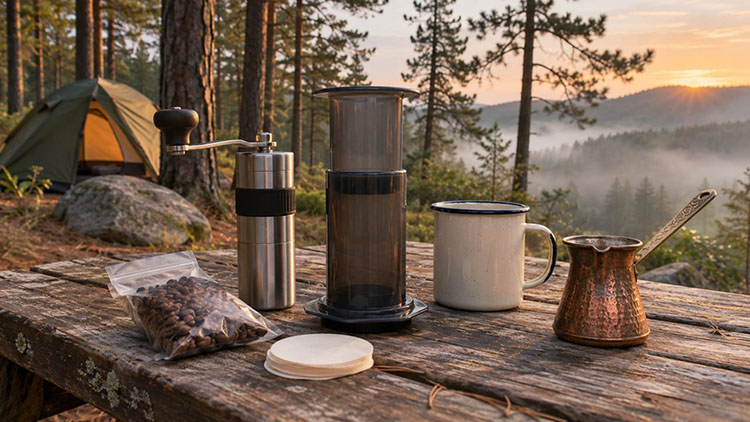
Our guide to making coffee while camping covers the brewing methods. This companion guide focuses on the objects themselves: what to look for, what to test before leaving, and how to build a kit you will enjoy carrying.
Start With the Trip, Then Choose the Equipment
Before comparing brewers, answer three questions: how far will you carry your kit, how many people need coffee, and how will you heat water?
For a walking holiday, packed size and total weight matter every day. For a campsite reached by car, a comfortable handle and enough capacity for two may be more useful than saving a few grams. If you already carry a cooking pot, choosing a brewer that uses water from it avoids adding another kettle.
Count the complete setup. Advertised brewer weight may exclude its mug, filters, case, or accessories. Weigh the items you will actually pack, including the coffee.
Hand grinder | Dose capacity, grip, adjustment, and packed handle | Grinding several batches before everyone has a drink |
Turkish coffee pot | Usable volume, handle, and stove support | A narrow base that sits poorly on the burner |
AeroPress | Exact model, mug fit, filters, and packed dimensions | Taking a cup that cannot safely support pressing |
Pour-over dripper | Filter fit and stability on your mug | An awkward pour from a wide cooking pot |
Mug | Capacity, base stability, and brewer compatibility | Choosing insulation without checking the opening |
Coffee container | Seal, portion size, and protection from moisture | Carrying a bulky container for a small amount of coffee |
Hand Coffee Grinders: When Fresh Grinding Is Worth the Space
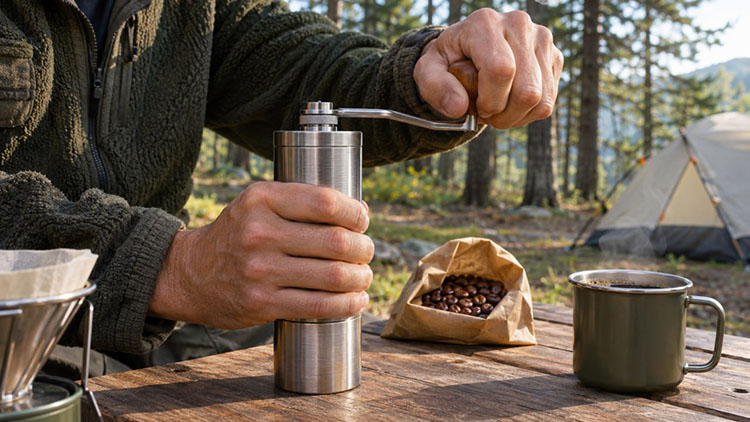
A manual coffee grinder lets you carry whole beans and adjust the grind at camp. It is particularly useful when the same coffee will be brewed in different ways, or when grinding each morning is part of the pleasure of the trip.
For a short weekend, coffee ground shortly before departure and sealed in small portions is also a practical choice. A grinder is an optional part of the kit, not a requirement for a worthwhile cup.
Choose the Grind Range Before the Finish
Start with your brewer. A pour-over, a Turkish pot, and an AeroPress recipe may require quite different settings.
Turkish coffee requires a powder-like grind. Do not assume that every hand grinder, or every grinder described as suitable for espresso, will produce that grind comfortably. Look for explicit manufacturer guidance for the exact model. For example, 1Zpresso’s E-Pro and Z-Pro instructions include a Turkish grind range; that guidance should not be copied across to unrelated grinders.
An AeroPress can work with different grind sizes depending on the recipe. For travel, choose one recipe, test its setting at home, and note it down. Click numbers are specific to the grinder and its adjustment system.
Match Capacity to Your Morning Routine
Check how much coffee fits in both the bean hopper and the grounds container. If your recipe uses 15 grams and two people want coffee, a grinder that holds one dose will require two rounds.
That may be perfectly acceptable. The useful question is whether you will still find it acceptable with cold hands, before breakfast, while someone waits for the stove.
Test Grip and Handle Storage
A narrow, smooth body may be awkward to hold. A long crank can be comfortable to turn but inconvenient to pack. Removable or folding handles can help, provided they are secured so they cannot disappear into the bottom of a bag.
Test the grinder with your actual beans and intended setting. Very fine grinding can demand more time and effort than a coarser setting. A quick kitchen trial tells you more about that workload than a product photograph.
Keep the Grinding Mechanism Dry
Pack a small brush if the grinder’s instructions call for dry cleaning. Comandante advises against soaking its grinders or putting them in a dishwasher, while 1Zpresso’s cited manual warns against washing the grinder with water. Follow your own model’s care instructions, including any separate guidance for removable containers.
At camp, keep the grinder away from rain, kettle steam, and wet washing-up gear. Let a rinsed brewer dry before packing it beside the grinder.
Turkish Coffee Pots: Check the Base and Handle First
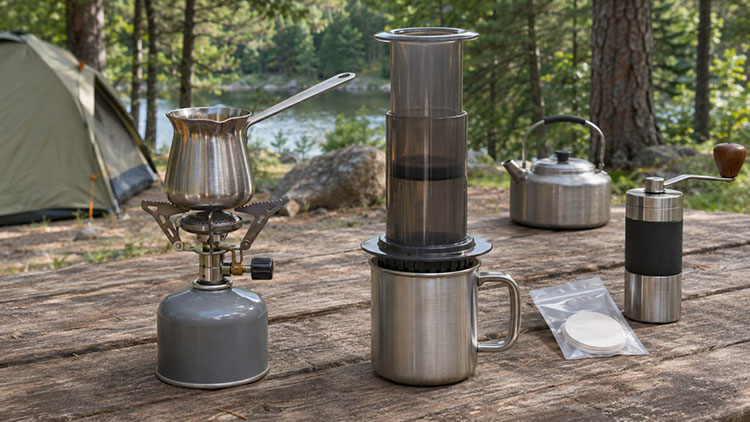
A Turkish coffee pot, or cezve, combines the brewing vessel and heating vessel in one object. It is a good fit for someone who enjoys a small, concentrated, unfiltered coffee and is happy to watch the pot as it heats.
It also creates a different packing problem from an AeroPress: the most important compatibility check is between the pot and the stove.
Make Sure the Stove Can Support It
Some small pots have a base that does not sit securely across widely spaced stove supports. Place the empty pot on your unlit stove at home and check that it sits flat without rocking or slipping.
If the stove requires a manufacturer-approved support accessory for small vessels, include that accessory in your packing plan. Avoid improvised supports that can shift when the pot is full of hot liquid.
Choose a Useful Brewing Volume
Turkish coffee is typically served in small cups, so a pot advertised for several servings may still make much less coffee than a large camping mug holds.
Check its capacity in milliliters and leave space for foam to rise. Do not assume that the brimful capacity is the amount you can comfortably brew. For two people, choose a pot that accommodates your intended recipe without filling it to the rim.
Compare Materials Through Their Practical Details
Stainless steel is worth considering for a straightforward travel setup, but inspect the whole pot: base shape, handle attachment, weight, and cleaning access all matter.
Copper pots may have an interior lining that requires particular care. Follow the manufacturer’s directions for cleaning, heating, and inspecting that lining. Titanium can be attractive where low weight matters, but price, construction, and heat control still deserve attention.
Material alone does not tell you whether a pot will balance on your stove or pour neatly into your cup.
Keep the Handle Away From Heat
A folding handle can save space, while a fixed handle may feel more secure. Check for play in the attachment and make sure you can lift and pour comfortably.
Do not assume that a metal body makes every handle safe near a campfire. Wood, plastic, coatings, and handle joints may have heat limitations. Use the heat source permitted by the manufacturer, keep flames from wrapping around the pot, and never leave it heating unattended.
For brewing, use a tested dose and a gentle, controllable heat. Remove the pot as the foam rises rather than letting it boil over. Allow the grounds to settle before drinking; a cezve does not filter them out.
AeroPress: Build the Kit Around the Mug
An AeroPress separates the coffee from the grounds through a filter, making it appealing when you want a filtered cup and a compact brewer. It still requires a separate source of hot water.
Its practical advantage at camp is that the brewer can be used away from the flame. Heat water in your cooking vessel, move to a stable surface, and brew there.
Compare Exact Models
Do not treat all AeroPress models as interchangeable. Chamber size, included accessories, packed dimensions, and compatible cups vary.
The AeroPress Go is designed to pack into its own mug. Other versions use different arrangements, so check the exact product and package contents before assuming that a travel cup or filter holder is included.
Compare the complete travel configuration. A smaller brewer plus an extra mug and case may occupy more space than you expected.
Choose a Stable, Compatible Cup
The cup must support the brewer securely and withstand the downward force of pressing. AeroPress’s instructions specify a sturdy mug. Its FAQ also cautions that glass vessels used for pressing must be sturdy.
Check the opening, the contact between brewer and rim, and the stability of the base. A soft folding cup or a narrow, top-heavy vessel may be convenient to carry but unsuitable for this job.
Use a level surface and press gently. If resistance is unusually high, stop and check the grind and assembly instead of forcing the plunger.
Bring Filters That Fit
Paper filters are easy to portion for a trip. Keep them dry in a small sealed pouch and pack a few extras.
A compatible reusable metal filter is another option, but it changes the cup and the cleanup. It can allow more oils and fine particles through, and it needs cleaning after use. Choose according to the coffee you like and the water you can spare.
Keep the Recipe Simple
Test one upright recipe before departure. As a starting experiment, try 15 grams of coffee with about 200 grams of hot water, provided this fits your model with adequate room for the plunger. Stir carefully, steep for around a minute, and press slowly. Adjust at home for your coffee, grind, and preferred strength.
This is a suggested starting recipe, not a universal manufacturer formula. If you want a larger drink, you can test a stronger brew and dilute it in the mug afterward.
For two people, plan for separate brews or a tested concentrate recipe. Check the actual serving volume rather than relying on a product’s stated cup count.
The Supporting Gear That Makes the Kit Work
A Cooking Vessel You Can Pour From
A separate gooseneck kettle is optional. Before buying one, try pouring from the pot you already carry.
For an AeroPress, the main concern is adding water safely. A pour-over demands more control, so the shape of the pot’s rim and handle becomes more noticeable. Practice while the vessel is comfortably filled, not just with a little cold water.
Coffee Packed in Useful Portions
For a short trip, portion coffee by brew. This reduces morning measuring and makes it easier to see how much remains. If carrying beans in one container, bring a measuring method you have checked against your recipe at home.
A scoop is convenient, but it does not measure every coffee identically. Bean size, roast, and grind affect how much fits inside it.
A Small Cleanup Kit
Bring a sealable waste bag for grounds and used paper filters, plus a small cloth if useful. Empty most grounds into the waste bag before rinsing your brewer, and carry the waste out with you.
Use safe drinking water for brewing and follow local water-treatment guidance. A clear-looking stream is not proof of safe water, and an ordinary coffee filter is not a water purifier.
Three Practical Camping Coffee Kits
Short walking trip | Pre-ground portions, compact dripper, paper filters, mug, existing cooking pot | Avoids carrying a grinder and uses the cooking equipment already packed |
Solo trip with a fresh-coffee ritual | Hand grinder, AeroPress, compatible sturdy mug, filters, cooking pot | Allows grind adjustment and a filtered cup without placing the brewer on the stove |
Relaxed campsite stay | Hand grinder verified for Turkish coffee, suitable cezve, compatible stove, small cups | Suits unhurried preparation and small servings of unfiltered coffee |
These are starting points. If you already own suitable gear, assemble it and make a complete cup before replacing anything. You may discover that the missing item is a better-fitting mug rather than a different brewer.
Frequently Asked Questions
Do I need a hand grinder for camping?
No. For a short trip, pre-ground coffee in sealed portions can be the more convenient option. Bring a grinder if fresh grinding and adjustment are worth the extra equipment and effort to you.
Can one grinder work for AeroPress and Turkish coffee?
Potentially, but check its documented grind range. Turkish coffee requires a powder-like grind, and a grinder suitable for an AeroPress recipe is not automatically a comfortable choice for a cezve.
Can I put an AeroPress on a camping stove?
No. Heat water separately and use the brewer according to its instructions. It is not a stovetop pot.
Is a Turkish coffee pot better than an AeroPress?
They suit different preferences. A cezve produces unfiltered coffee and needs compatible, controlled heat. An AeroPress uses a filter and requires hot water plus a sturdy receiving vessel. Choose around the drink and routine you prefer.
What should I test before leaving?
Make a complete brew using only the items in your packed kit. Check the grind, water measurement, stove support, mug fit, serving size, cleanup, and packing. That single rehearsal reveals small compatibility problems while they are still easy to fix.
