
You wake up, switch on your espresso machine, grind your favorite beans, and prepare your first coffee of the morning. Everything looks normal, but something is missing.
The espresso tastes slightly sour, thinner than usual, or strangely unbalanced.
A few minutes later, you prepare another shot using the same beans, grind setting, and recipe. This time, the coffee tastes richer, sweeter, and more satisfying.
Sound familiar?
Your first espresso shot can taste different because the machine, grinder, and brewing components may not yet be in the same condition as they are during subsequent extractions.
Temperature is often the biggest suspect, but it isn’t the only explanation. A cold portafilter, retained coffee grounds, changing thermal conditions, and even your morning taste perception can contribute.
Let’s explore what happens inside your espresso machine during those first few minutes and how to make your first shot as good as your second.
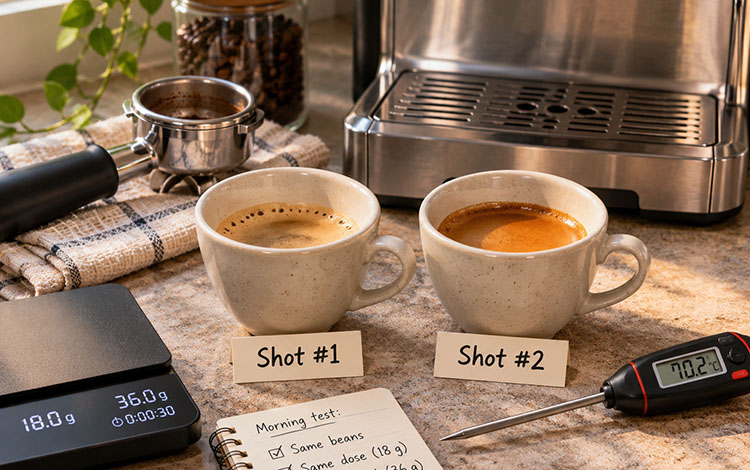
1. Your Espresso Machine May Not Be Fully Warm
One of the most common reasons the first espresso shot tastes bad is insufficient machine warm-up.
Many home espresso machines indicate that they are ready to brew shortly after being switched on. However, the ready light doesn’t necessarily mean that every component involved in extraction has reached a stable temperature.
Inside an espresso machine, heat must travel through several components:
- The boiler or thermoblock heats the brewing water.
- The group head transfers heat to the brewing assembly.
- The portafilter and filter basket absorb heat.
- The incoming water and surrounding components influence brewing temperature.
These parts do not necessarily warm up at the same speed.
Why temperature matters
Espresso extraction involves dissolving and carrying flavor compounds from finely ground coffee into water.
Temperature affects how quickly different compounds are extracted. If the brewing water loses too much heat before passing through the coffee puck, extraction can become less efficient.
The result may be a shot that tastes unusually sharp, thin, or underdeveloped.
Many espresso recipes use brewing temperatures around 90–96°C (194–205°F), although the ideal setting depends on the coffee, roast level, and machine.
A machine can reach its programmed water temperature while its group head or portafilter remains relatively cool.
When you brew the first shot, these colder parts absorb some of the heat. During the second extraction, they may already be warmer, reducing the temperature difference.
However, the effect varies considerably between machines.
How long should an espresso machine warm up?
There is no universal warm-up time.
Some compact machines are designed to brew quickly. Others benefit from a considerably longer warm-up period.
The best approach is to follow your machine’s instructions and test whether additional warm-up improves consistency.
