
Your espresso machine is warm, the beans are fresh, and the crema looks inviting. Yet the first sip tastes sharply sour, unpleasantly bitter, or somehow both.
An unpleasant shot does not automatically mean your machine needs repairing. Often, the explanation lies in grind size, coffee dose, beverage yield, or brewing temperature. The challenge is that similar flavors can have different causes.
This guide explains how to identify the problem and make useful adjustments one at a time. It mainly applies to semi-automatic espresso machines with conventional single-wall baskets. Superautomatic machines and pressurized baskets offer different levels of control.
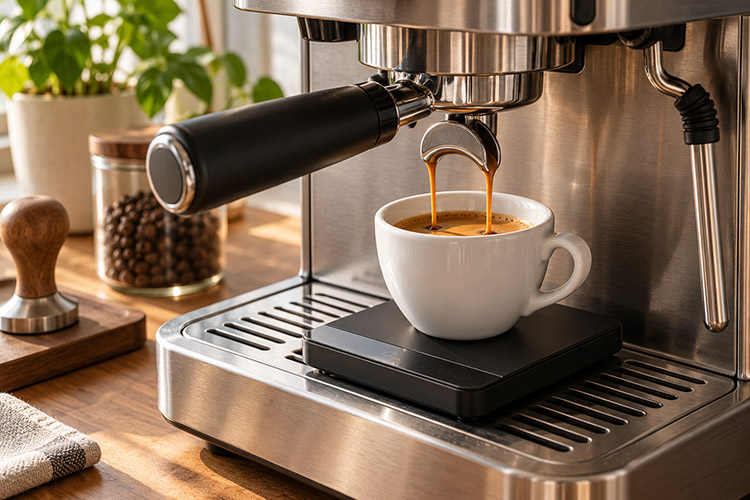
Is Your Espresso Sour, Bitter, or Astringent?
A good espresso can contain both acidity and bitterness. What matters is how they fit together.
Pleasant acidity might remind you of ripe apples, berries, or citrus. When it comes with sweetness and a clean finish, it can be part of the coffee’s appeal.
Unpleasant sourness feels sharp and unbalanced. The shot may taste like underripe fruit, seem hollow, or have a slightly salty edge. Insufficient extraction is one possible explanation.
Bitterness can range from gentle cocoa notes to harsh, smoky flavors. Both the roast and the brewing process affect it.
Astringency is the drying, puckering sensation you might recognize from oversteeped tea. It is often described as bitterness, but recognizing the difference makes troubleshooting easier.
Before judging a shot, stir it and let it cool slightly. This mixes the layers and helps you assess the whole drink rather than the crema alone.
What Does Espresso Extraction Mean?
Extraction happens when water dissolves soluble substances from ground coffee. Flavor depends on how much is extracted and how evenly water moves through the coffee puck.
Extraction and strength are related, but they are different:
- Extraction describes how much soluble material has been removed from the grounds.
- Strength describes how concentrated the finished drink is.
A short shot can be intense yet sharply sour. A longer shot may taste less concentrated while being more fully extracted. Increasing beverage yield at a fixed dose generally raises extraction while lowering concentration.
Start with a Repeatable Recipe
Use the roaster’s recommended recipe if one is available. Otherwise, the following can serve as a starting point for a medium roast:
Variable
| Starting point
|
These numbers provide a baseline rather than a pass-or-fail test. Basket capacity determines a suitable dose, and individual coffees may benefit from a different ratio or shot time.
A 1:2 brew ratio means using 18 g of ground coffee to produce 36 g of liquid espresso. Measure the drink by weight because crema makes volume inconsistent.
Time each shot the same way, such as from pump activation. If your machine has a long pre-infusion stage, account for that when comparing results.
Why Is My Espresso Sour?
1. The shot runs too quickly
If your target yield arrives unusually quickly and the espresso tastes sharp and thin, the grind may be too coarse.
Try this: move slightly finer, keep the same dose, and stop at the same beverage weight. Compare the flavor.
Avoid relying on harder tamping to fix a fast shot. A level puck and an appropriate grind setting are more useful.
2. The beverage yield is too short
An 18 g dose producing only 27 g of espresso may create a concentrated shot without enough balance.
Try this: keep the dose and grind unchanged and increase the yield to around 32–36 g. If you already produce 36 g, test 40 g as a separate adjustment.
Notice the change in texture as well as flavor. The longer shot may taste more balanced while feeling lighter.
3. The machine and portafilter need more warming
A ready light does not always mean every component has reached a stable brewing temperature. If the first shot consistently tastes sharper than later shots, review your warm-up routine.
Try this: follow the manufacturer’s warm-up instructions, keep the portafilter in the group while heating, and preheat the cup. Repeated water flushes are not a universal substitute for proper warm-up.
4. The coffee naturally has a bright flavor
Some light roasts and fruit-forward coffees retain noticeable acidity even when brewed well.
Try this: ask whether the acidity is now supported by sweetness. If the shot tastes balanced but you still dislike its character, choose a medium roast with chocolate or nut notes.
Why Is My Espresso Bitter?
1. The beverage yield is too large
If the shot becomes thin toward the end and leaves a harsh finish, you may be pushing the recipe too far for those beans.
Try this: keep the dose and grind unchanged, but stop earlier. For example, reduce a 45 g yield to 36–40 g.
Avoid shortening the shot indefinitely. A very short espresso can become heavy and sour.
2. The grind is too fine and the flow is uneven
A shot that barely drips does not necessarily improve if you simply wait longer. An excessively fine grind can make even extraction harder to achieve.
Try this: move slightly coarser and repeat the shot with the same dose and target yield. Check whether harshness and dryness decrease.
3. The brewing temperature does not suit the roast
Once flow and yield are reasonably consistent, temperature can help refine the flavor.
Try this: for a harsh dark roast, lower the temperature by 1–2°C while keeping the other settings unchanged. For a light roast that remains sharply sour after recipe adjustments, test a small temperature increase separately.
Treat temperature as a fine adjustment after dose, yield, and grind.
4. The beans have a strongly bitter roast profile
Very dark beans can retain smoky or charred notes across several recipes. Robusta-containing blends also often have a more pronounced bitter character.
Try this: compare another roast. Brewing adjustments can improve balance, but they cannot transform the underlying flavor of the beans.
5. Old coffee residue is affecting the flavor
Coffee oils and residue in the basket, portafilter, and shower screen can add unpleasant flavors.
Try this: clean the relevant parts according to the manufacturer’s instructions. Only detergent-backflush machines designed for that procedure. Descaling and removing coffee oils are separate maintenance tasks.
Why Does Espresso Taste Sour and Bitter at the Same Time?
One possible explanation is channeling. Water finds easier routes through parts of the puck, leaving extraction uneven.
Possible clues include:
- large changes in shot time despite using the same recipe;
- flow that suddenly accelerates;
- sideways jets or spraying from a bottomless portafilter;
- a combination of sharp sourness, harshness, and dryness.
None of these signs proves channeling on its own. Together, however, they justify checking puck preparation.
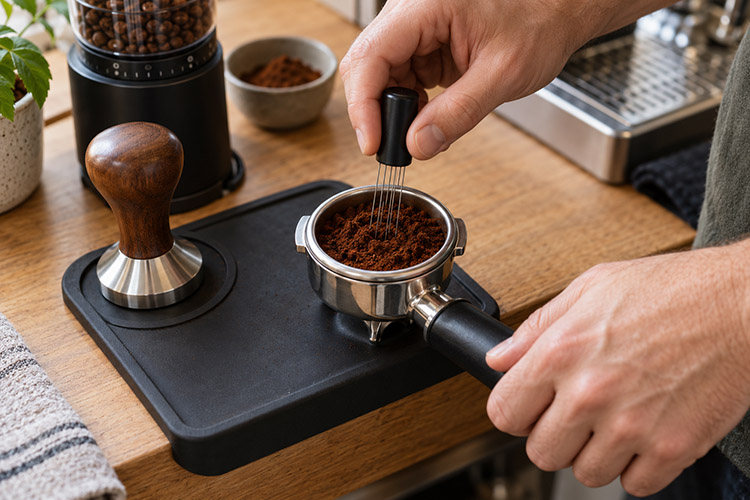
Distribute the grounds evenly, break up clumps, tamp level, and avoid knocking the portafilter after tamping. A fine-needle WDT tool can help with distribution. Check that your dose suits the basket.
Repeatedly grinding finer is not a guaranteed solution: finer settings do not always produce higher or more even extraction.
How Does Coffee Dose Affect the Shot?
Dose changes puck depth and resistance to water flow. If it changes with every shot, meaningful comparisons become difficult.
Choose a dose appropriate for the basket and keep it stable while adjusting other variables. Avoid forcing an 18 g recipe into a basket intended for a much smaller dose.
When you deliberately change the dose, recalculate the target yield. At a 1:2 ratio:
- 16 g coffee → 32 g espresso;
- 18 g coffee → 36 g espresso;
- 20 g coffee → 40 g espresso.
Adding more coffee is not a universal cure for sourness. If the beverage yield stays the same, you also change the brew ratio and the flow conditions.
Quick Espresso Troubleshooting Table
What you notice | Check first | First adjustment to test |
Sharp sourness with fast flow | Grind size | Grind slightly finer; keep dose and yield unchanged |
Sour, concentrated, very short shot | Beverage yield | Increase yield slightly |
Harsh bitterness with a large yield | Brew ratio | Stop the shot earlier |
Bitter, drying shot that barely drips | Grind and puck preparation | Grind slightly coarser |
Sourness and bitterness together | Extraction evenness | Improve distribution and level tamping |
First shot tastes worse than later shots | Warm-up routine | Make preheating consistent |
Ashy flavor across several recipes | Roast and equipment cleanliness | Clean the equipment, then compare different beans |
A Practical Dial-In Routine
- Warm the machine and start with a clean, dry basket.
- Weigh a dose suitable for your basket.
- Choose a target yield and place the cup on a scale.
- Pull the shot and record its yield and time.
- Stir, let it cool slightly, and taste.
- Change one variable.
- Pull another shot and compare.
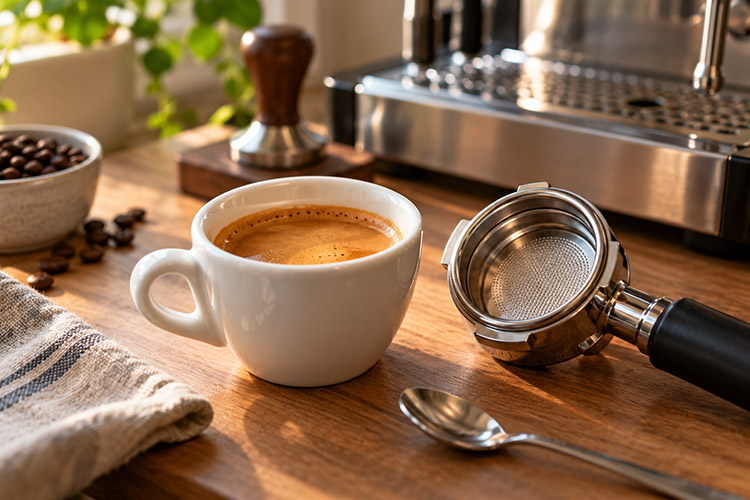
For example, imagine 18 g in and 36 g out in 18 seconds, with a sharply sour result. A sensible first test is a slightly finer grind while keeping the dose and yield unchanged.
If the shot improves but still tastes too sharp, test a 40 g yield next. Recording each recipe makes it easier to identify which adjustment helped.
Frequently Asked Questions
Can You Steam Milk Twice?
Measure a fresh cold portion for each drink. Reheating makes flavour and texture less predictable. Avoid topping up leftover warm milk with cold milk for another steaming cycle, and do not return leftovers to the carton.
Do You Need a Thermometer?
It is useful while learning because it shows how much time you have for aeration and when to stop steaming. Feeling the pitcher gives only a rough sense of warmth, not an accurate temperature.
Why Is Latte Art Difficult Even When There Is Foam?
Latte art needs fluid, integrated milk. If the foam pours out as a separate lump, introduce less air and improve circulation. Then work on pouring height and flow rate.
What Is the Fastest Way to Improve?
Keep the milk, portion size and pitcher consistent for several attempts. Change one variable at a time: tip depth, aeration time or final temperature. That makes it easier to identify which adjustment helped.
