
Have you ever made a cup of coffee that tasted pleasantly balanced at first, only to discover fruity, chocolatey, or unexpectedly sour notes ten minutes later?
You haven’t changed the beans, added anything to your cup, or adjusted your coffee machine. Yet the drink seems completely different.
Temperature is one of the most underestimated factors in coffee tasting. It influences how we perceive sweetness, bitterness, acidity, aroma, and even the texture of a drink.
Interestingly, some high-quality coffees become more enjoyable and complex as they cool. Others reveal unpleasant characteristics that were difficult to notice when the coffee was hot.
Understanding why this happens can change the way you drink, evaluate, and prepare coffee at home.
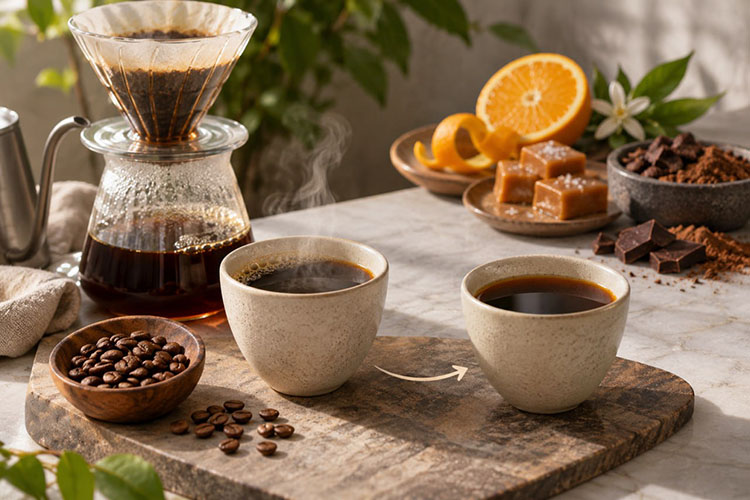
What Happens to Coffee as It Cools?
A freshly brewed cup of coffee contains hundreds of chemical compounds that contribute to its flavor and aroma. These include organic acids, volatile aromatic compounds, caffeine, and substances formed during roasting.
When coffee cools, its chemical composition does not immediately undergo a dramatic transformation. Instead, much of the perceived change comes from the way our senses respond to different temperatures.
Several processes occur simultaneously:
- The sensitivity of our taste system changes.
- Volatile aromatic compounds are released at different rates.
- Heat becomes less dominant in the overall sensory experience.
- The balance between sweetness, acidity, and bitterness becomes easier to distinguish.
- Some aromatic compounds gradually escape or undergo chemical changes.
In other words, the same cup of coffee can provide several different tasting experiences.
How Temperature Affects Coffee Flavor
Coffee does not have a single ideal tasting temperature. Different temperature ranges can reveal different characteristics.
Above 65°C / 149°F | Heat can dominate the experience, making subtle flavors difficult to identify. Allow the drink to cool. |
55–65°C / 131–149°F | Aroma remains prominent, while individual flavors become easier to recognize. |
45–55°C / 113–131°F | Sweetness, acidity, and flavor complexity may become more noticeable. |
30–45°C / 86–113°F | Fruity notes, acidity, and extraction-related imperfections may become clearer. |
Below 30°C / 86°F | The flavor profile changes further, while some volatile aromas become less noticeable. |
*These ranges are approximate rather than universal. Roast level, brewing method, coffee concentration, and individual taste sensitivity all influence the result.
Why Coffee Can Taste Sweeter as It Cools
Natural coffee sweetness is not simply a matter of sugar content.
It is a sensory impression influenced by aromatic compounds, acidity, bitterness, and the products of chemical reactions that occur during roasting.
When coffee is very hot, it can be difficult to distinguish delicate sweet notes. As the temperature decreases, these characteristics may become easier to recognize.
Depending on the beans, you might discover flavors reminiscent of:
- Caramel
- Honey
- Milk chocolate
- Ripe fruit
- Vanilla
- Brown sugar
A coffee that initially seems strong and straightforward may develop a surprisingly soft and sweet finish.
However, cooling does not automatically make every coffee sweeter. The result depends on the original flavor balance.
Why Coffee Often Tastes More Acidic When It Cools
Acidity is a natural characteristic of coffee, particularly in lighter roasts.
When coffee is hot, acidity may be less distinguishable from other sensations. As the drink cools, citrus, berry, apple, and other fruit-like notes can become more pronounced.
This does not necessarily mean that the coffee has become chemically more acidic. Often, you are simply perceiving its existing acidity differently.
It is also important to distinguish pleasant acidity from unpleasant sourness.
Pleasant acidity creates brightness, freshness, and complexity. Unpleasant sourness can make coffee taste sharp, hollow, or unbalanced.
If your coffee becomes aggressively sour as it cools, possible causes include under-extraction, an unsuitable grind size, insufficient brewing temperature, or a roast profile that does not match your preferences.
Does Coffee Become More Bitter as It Cools?
Not necessarily.
The relationship between temperature and bitterness is complex. Some bitter sensations may become less intense at lower temperatures, while unpleasant bitter notes can become easier to identify as the overall flavor balance changes.
Dark-roasted coffee, for example, may reveal smoky, burnt, or harsh characteristics as it cools.
An unbalanced extraction can also produce a lingering bitter or drying finish that was less obvious when the drink was hot.
Cooling does not create these defects from nothing. It can simply make them more noticeable.
Why Coffee Aroma Changes with Temperature
Aroma is a major part of what we experience as coffee flavor.
Hot coffee releases volatile aromatic compounds into the air relatively quickly. This is why freshly brewed coffee often has such a powerful and recognizable smell.
As the temperature decreases, the release of these compounds changes. Some aromas become weaker, while others may become easier to distinguish because the overall sensory balance has shifted.
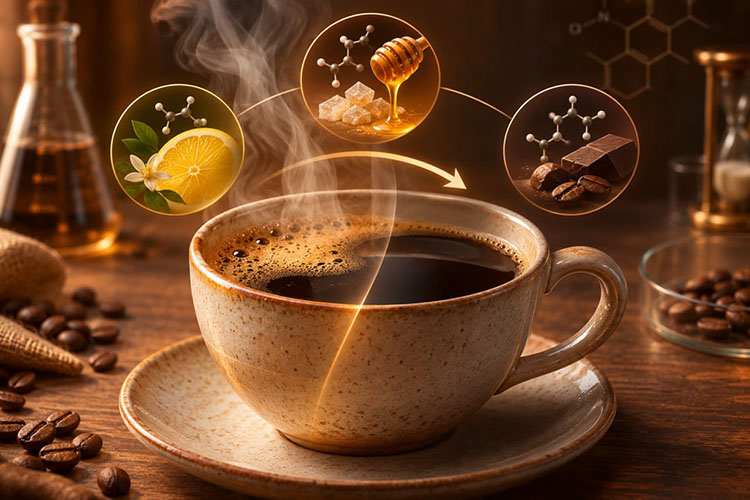
This is one reason why coffee can smell less intense but taste more complex after several minutes.
Our perception also depends on retronasal olfaction — the aromas that reach the nose from inside the mouth while we drink.
Coffee tasting is therefore a combination of taste, smell, temperature, and texture rather than taste alone.
Why Good Coffee Can Become More Interesting as It Cools
A well-balanced specialty coffee can offer a remarkable progression of flavors.
Imagine a light-roasted Ethiopian coffee:
- When hot, it may have a delicate floral aroma.
- After several minutes, citrus and honey-like notes may become clearer.
- As it cools further, berry-like flavors and a juicy finish may emerge.
A medium-roasted Brazilian coffee might develop differently, moving from roasted nuts and cocoa toward caramel and chocolate.
These are illustrative examples, not guaranteed flavor profiles for every coffee from these countries.
The important point is that a balanced coffee can remain enjoyable across several temperatures, even when its dominant flavors change.
This is one reason professional coffee tasters evaluate coffee at multiple stages of cooling rather than relying on the first sip.
What Cooling Can Reveal About Your Coffee
The way coffee tastes after cooling can provide useful clues about beans, roasting, and brewing.
Pleasant fruitiness | Natural acidity and aromatic complexity |
Increased perceived sweetness | A more distinguishable balance of flavors |
Sharp, unpleasant sourness | Under-extraction or an unsuitable roast profile |
Dry, harsh bitterness | Uneven extraction, excessive extraction, or dark roasting |
Stale or cardboard-like notes | Aging beans or oxidation |
Weak, watery flavor | Low coffee concentration or an unbalanced recipe |
*These observations are starting points, not definitive diagnoses. Several different brewing problems can produce similar flavors.
Does the Brewing Method Make a Difference?
Different brewing methods create different concentrations, textures, and extraction profiles. As a result, they can also produce different flavor changes during cooling.
Espresso
Espresso is highly concentrated and cools relatively quickly because of its small volume.
As it cools, its acidity, sweetness, bitterness, and texture may become easier to evaluate. An unbalanced espresso can develop a particularly noticeable sour or bitter finish.
Automatic Coffee Machines
Bean-to-cup machines can produce very different results depending on grind settings, coffee dose, beverage volume, and brewing temperature.
Tasting the same coffee at several temperatures can help you determine whether adjusting the machine’s settings improves its overall balance.
Pour-Over Coffee
Filter coffee is particularly suitable for exploring flavor development during cooling.
Its relatively clean texture often makes subtle floral, fruity, and sweet characteristics easier to distinguish.
French Press
French press coffee generally has a fuller body and contains more oils and fine particles than paper-filtered coffee.
Its texture and heavier flavor characteristics can influence how sweetness and bitterness are perceived as the drink cools.
For a fair tasting experiment, pour the coffee into a separate cup after brewing rather than leaving it in contact with the grounds.
A Simple Coffee Tasting Experiment You Can Try at Home
You do not need expensive equipment or professional tasting skills to explore how temperature affects coffee.
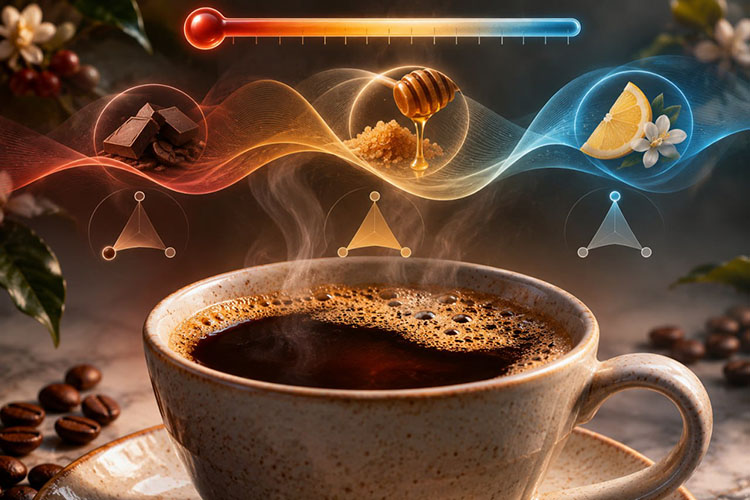
You only need a freshly brewed cup, a timer, and optionally a kitchen thermometer.
Step 1: Brew your usual coffee
Use your normal beans, grind size, and brewing method. Black coffee works best for this experiment because milk and sugar can mask some flavor differences.
Step 2: Taste it when comfortably hot
Once the coffee is safe and comfortable to sip, evaluate its aroma, sweetness, acidity, and bitterness.
Write down your first impressions.
Step 3: Taste it again after five minutes
Look for flavors that were not obvious during the first tasting.
Has the coffee become sweeter? Is the acidity more noticeable? Can you identify chocolate or fruit notes?
Step 4: Repeat after ten and twenty minutes
Observe how the balance changes as the coffee approaches room temperature.
If you have a thermometer, record the actual temperature at each stage.
First comfortable sip | Record temperature | Aroma and initial flavor balance |
After 5 minutes | Record temperature | Sweetness and emerging flavors |
After 10 minutes | Record temperature | Acidity and complexity |
After 20 minutes | Record temperature | Aftertaste and possible imperfections |
Cooling speed depends on cup material, beverage volume, and room temperature, so your results may differ.
You might discover that your favorite coffee tastes best several minutes after brewing rather than immediately.
Is Reheated Coffee the Same as Freshly Brewed Coffee?
Not quite.
Reheating coffee can restore its temperature, but it cannot fully restore aromatic compounds that have already escaped.
Coffee that has been sitting for a long time may also undergo oxidation and other chemical changes that affect its flavor.
A freshly brewed cup that has cooled naturally is therefore not necessarily equivalent to an old cup that has been reheated.
The longer coffee sits, particularly when kept hot for an extended period, the more its flavor may deteriorate.
Is Cooled Coffee the Same as Cold Brew?
No. These are two different experiences.
Cooled coffee is brewed using hot water and then allowed to cool.
Cold brew is generally prepared using cool or room-temperature water over a much longer extraction period.
Because brewing temperature influences which compounds are extracted and at what rate, cold brew can have a different balance of acidity, aroma, bitterness, and body.
Simply allowing hot coffee to cool does not turn it into cold brew.
How to Make Coffee That Tastes Good Even After Cooling
If you want your coffee to remain enjoyable at different temperatures, focus on the quality and balance of the original brew.
- Use fresh, properly stored coffee beans.
- Choose a roast level that matches your taste preferences.
- Adjust grind size gradually.
- Use a consistent coffee-to-water ratio.
- Follow suitable brewing temperature recommendations for your brewing method.
- Keep your coffee machine and grinder clean.
- Taste coffee at several temperatures before changing your recipe.
A good cup of coffee does not need to taste identical from beginning to end. Its changing flavor can be part of the experience.
Frequently Asked Questions
Why does my coffee taste sour when it gets cold?
Lower temperatures can make existing acidity easier to notice. Excessive sourness may also indicate under-extraction, an unsuitable brewing recipe, or a roast profile that is too acidic for your preferences.
Does coffee become more acidic as it cools?
Not necessarily. Perceived acidity can increase without a substantial immediate change in the coffee’s chemical acidity.
What is the best temperature for tasting coffee?
Many people find that coffee reveals more distinguishable flavors around 45–60°C (113–140°F). However, there is no universal ideal temperature.
Does coffee lose caffeine as it cools?
No. Ordinary cooling does not significantly reduce the amount of caffeine in a cup of coffee.
Why does expensive coffee sometimes taste better when it cools?
High-quality beans with a balanced roast and extraction can offer complex aromatic and flavor characteristics that become easier to distinguish at lower temperatures. Price alone, however, does not guarantee quality.
Does coffee lose its flavor when it gets cold?
Some aromas become less noticeable, but other flavor characteristics may become clearer. Prolonged storage, rather than cooling alone, can contribute to flavor deterioration.
Final Thoughts
The first sip of coffee does not always tell the whole story.
As coffee cools, the relationship between aroma, sweetness, acidity, bitterness, and texture changes. A cup that initially seems ordinary may reveal unexpected complexity, while an unbalanced brew may expose its weaknesses.
The next time you prepare coffee, resist the temptation to finish it immediately.
Taste it at different temperatures and pay attention to what changes.
You may discover that the most interesting part of your coffee experience begins when the steam disappears.
