
You pour a fresh cup of coffee, take a sip, and love it. Then a phone call interrupts you. Twenty minutes later, you return to the same mug—and the coffee tastes surprisingly different. Maybe it seems sharper, less aromatic, or more bitter. What changed?
Short answer: As coffee cools, temperature changes the way you perceive taste, aroma compounds escape into the air, and the drink gradually changes while it sits. The effect depends on the beans, roast, brewing method, and your own palate. Cooler coffee isn’t automatically worse; sometimes it reveals flavors you couldn’t notice when it was hot.
1. Temperature changes how you experience taste
Your sense of taste is influenced by temperature. The intensity of sweetness, bitterness, and sourness can shift as a drink gets warmer or cooler, but there is no single rule that applies to every coffee or every person.
When coffee is very hot, heat can make it harder to distinguish delicate flavors. At a more comfortable drinking temperature, you may find the cup easier to evaluate. As it cools further, certain acidic, bitter, or astringent sensations may become more prominent. This is a change in perception, not proof that the coffee has suddenly gained more acid or caffeine.
2. The aroma changes as volatile compounds escape
Much of coffee’s flavor experience comes from aroma. Freshly brewed coffee releases a complex mixture of volatile compounds associated with floral, fruity, nutty, roasted, and chocolate-like notes.
Warmth helps release these compounds into the air. That’s why a freshly poured cup can smell especially intense. Over time, some of the more volatile compounds dissipate, while cooling also changes how much aroma reaches your nose. The result may seem less fragrant or simply different – not necessarily flavorless.
3. Acidity can become easier to notice
As the temperature falls, you may notice the coffee’s acidity more clearly. In a well-extracted light roast, that can reveal pleasant citrus, berry, or stone-fruit impressions. In a poorly balanced brew, it can make sharp sourness harder to ignore.
However, 40°C (104°F) is not a universal threshold at which coffee suddenly becomes sour. What you taste depends on the coffee and how it was brewed. Professional coffee tasters evaluate samples at multiple temperatures for exactly this reason: a single hot sip does not tell the whole story.
4. Coffee continues to change while it sits
Cooling and aging are related but different processes. Temperature can alter your perception almost immediately. Leaving brewed coffee exposed to air for an extended period can also lead to changes in aroma and other compounds through oxidation and related reactions.
These changes are gradual, and their speed depends on time, temperature, oxygen exposure, and the drink’s composition. They do not mean that every cup becomes chemically bitter within minutes. Coffee held for a long time on a hot plate can develop a less pleasant flavor, partly because prolonged heating accelerates deterioration and aroma loss.
5. Body and mouthfeel may feel different
Temperature also affects the drinking experience beyond the basic tastes. A coffee that feels smooth and rounded when warm may seem thinner, drier, or more astringent when cool. Some coffees show the opposite pattern and become more balanced as they approach room temperature.
Milk, sugar, brewing strength, and suspended coffee oils can all influence these impressions, so compare like with like when tasting.
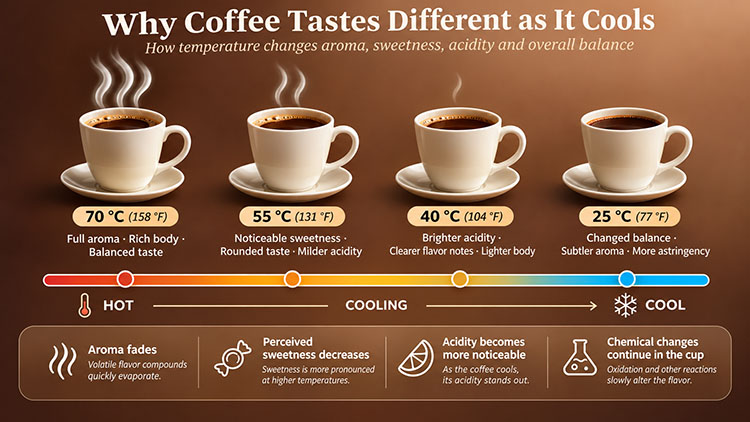
What does coffee taste like at different temperatures?
The following temperatures are useful checkpoints for a tasting experiment, not guaranteed flavor profiles.
70°C / 158°F | Strong aroma release; the drink may still be too hot to assess comfortably. Let it cool before sipping. |
55°C / 131°F | Often a comfortable tasting point for noticing sweetness, balance, and distinctive notes. |
40°C / 104°F | Some fruit-like acidity, bitterness, or subtle flavor details may become easier to distinguish. |
25°C / 77°F | Aroma and balance can feel quite different; some coffees taste pleasant, while others seem flat or harsh. |
Try this simple coffee cooling experiment
- Brew one cup of black coffee using your usual beans and recipe.
- Allow it to cool to a safe sipping temperature; do not taste it while scalding hot.
- Take a small sip and note the aroma, sweetness, acidity, bitterness, and body.
- Taste again after approximately 5, 10, and 20 minutes, using a thermometer if you have one.
- Write down which temperature you prefer. Repeat with a different roast or brewing method.
You may discover that a coffee you considered too acidic when hot becomes beautifully balanced as it cools – or that an unpleasant note becomes more obvious. Both outcomes are useful clues about your beans and extraction.
How to keep coffee enjoyable for longer
- Preheat your mug if you prefer to drink slowly and want to reduce rapid heat loss.
- Use an insulated cup or thermos to slow cooling; a lid can also reduce aroma loss to the surrounding air.
- Brew smaller servings if you prefer the taste of freshly prepared coffee.
- Avoid prolonged hot-plate warming. Transfer a batch brew to an insulated carafe instead.
- Check your extraction if the coffee tastes unpleasantly sour or bitter even at a comfortable temperature. Grind size, dose, water temperature, and brew time all matter.
- Reheat carefully if needed. Microwaving does not restore lost aroma, but gentle reheating is not inherently guaranteed to make coffee bitter. Avoid overheating.
What is the best temperature to drink coffee?
There is no universal best drinking temperature. Many people enjoy coffee once it has cooled enough to sip comfortably, and a range around 50–60°C (122–140°F) can be a useful starting point for tasting. Preferences vary, and hotter drinks increase the risk of burns. If your cup is uncomfortably hot, wait.
For flavor exploration, try tasting the same coffee at several safe temperatures instead of judging it only at the moment it leaves the machine
Frequently asked questions
Why does my coffee taste sour when it gets cold?
Cooling can make existing acidity more noticeable. If the sourness is unpleasant, check whether the coffee was under-extracted, particularly if it tastes sharp even when warm. Cooler coffee is not automatically more acidic in a chemical sense.
Does coffee become more bitter as it cools?
Not necessarily. Bitterness may become more apparent as other sensations shift, but some coffees taste less harsh when cooler. Prolonged storage and heating can also change flavor over time.
Is cold coffee the same as cold brew?
No. Coffee brewed hot and left to cool is different from cold brew, which is extracted with cool or room-temperature water over a longer period. Their extraction conditions—and often their flavor profiles—differ.
Can I reheat coffee without ruining it?
You can reheat coffee gently, but warming it again will not recreate volatile aromas that have already escaped. Avoid boiling or repeatedly overheating the drink.
The bottom line
Coffee tastes different as it cools because temperature changes sensory perception, aroma release changes, and the brewed drink slowly evolves with time. Those changes are not always bad. Taste your next cup at a few different temperatures – you may find that its best moment comes well after the first sip.
