
You pull a shot, sip it, and knock the portafilter into the bin. Thump. Gone. Most of us never look at what falls out. But that little disc of spent grounds may offer clues about what happened during extraction — although its appearance can also change after the pump stops.
Key takeaway: A spent puck is a clue, not a verdict. Judge espresso by taste, yield and flow first.
The puck can’t taste your coffee for you. It can, however, give you clues when a shot tastes wrong and you don’t know why. Here’s how to read it — and when to stop listening.
First, a quick look at what a puck actually is
When you tamp, you build a compact bed of ground coffee. During extraction, hot water at around 9 bar pushes through that bed and dissolves oils, acids and sugars. What’s left is the puck: the coffee structure after the water has done its work.
A puck can show marks from the shower screen, water droplets or pressure release. Some marks may relate to extraction, but appearance alone cannot reliably reveal how evenly water flowed.
How to read your puck in 30 seconds
- Look before you knock. Remove the portafilter and check the top surface first. That’s where most clues live.
- Check the surface. Is it flat and even? Or does it have holes, cracks, a dent or a sloped side?
- Note the texture. Is it a firm cake, a soft mud or a pool of water?
- Knock it out and look at the bottom and sides. A puck that drops out cleanly is convenient, but neither a firm nor a messy puck proves how well the coffee extracted.
- Compare with the taste. Sour, bitter, thin or harsh? Put the visual clue next to the flavour. That’s where the real answer is.
The five puck types and what they mean
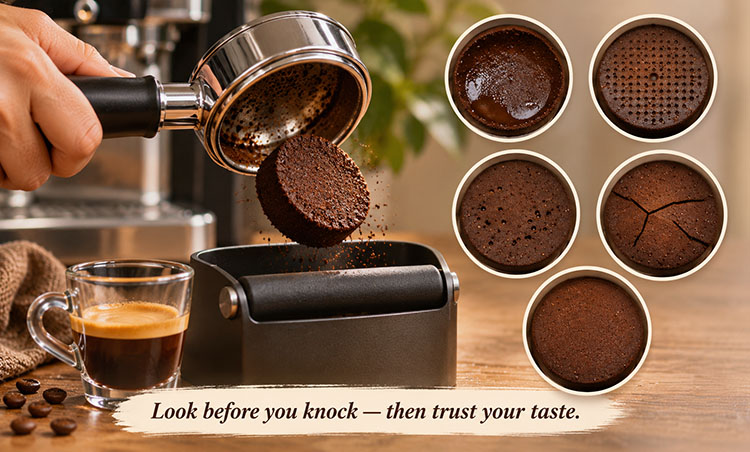
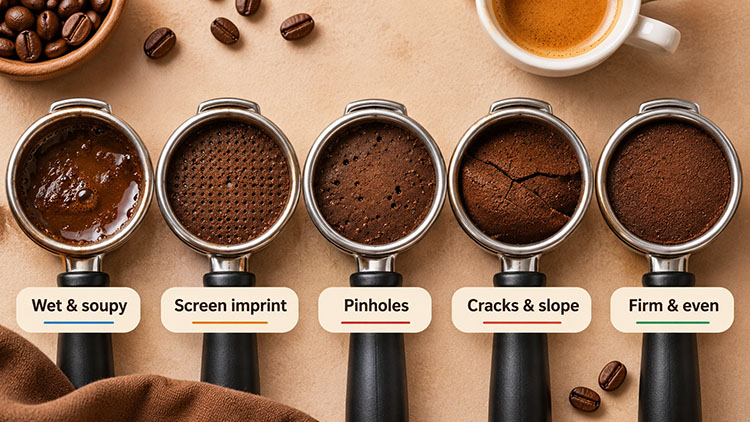
Wet, soupy puck with water on top | Residual water, basket design or a large gap above the coffee; machines without a three-way valve often leave wetter pucks | If the espresso tastes good, change nothing. If the dose is below the basket’s recommended range, test a small increase |
Puck stuck to the shower screen, with a screen imprint | A strong imprint or repeated sticking can suggest insufficient headspace; a faint mark alone is not conclusive | Check the basket’s dose range and shower-screen clearance; reduce the dose slightly if needed |
Small pinholes on the surface | Not reliable proof of channeling; holes may form as pressure drops or from water droplets | If the shot also flows unevenly or tastes inconsistent, improve distribution and tamp level |
Cracks or a crater, or one side lower than the other | Could reflect preparation, pressure release or puck removal; not a diagnosis by itself | If uneven flow repeats, distribute evenly and tamp level |
Dry, firm puck that knocks out in one piece | Common with machines that vent pressure through a three-way valve; appearance does not confirm extraction quality | Judge the espresso by taste, dose, yield and flow |
The soupy puck myth
The most common puck panic is the wet one. People see water sitting on top and assume the shot was ruined.
Usually it wasn’t. The water you see often lands on the puck after extraction, when the pump stops and the water above the coffee settles down. Many home and entry-level machines don’t have a three-way valve, which releases pressure and diverts residual water from the group to the drain. On those machines, a wet puck is simply normal.
A soupy puck alone is not a problem. If the shot also tastes thin, sour or watery, troubleshoot grind, dose and yield using the taste and flow as your primary clues. If it tastes sweet and balanced, the puck is just being dramatic.
What a puck can’t tell you
This is the part many guides skip. A beautiful puck does not guarantee a great shot, and an ugly puck doesn’t guarantee a bad one.
The puck can’t tell you:
- whether your grind size suits this bean;
- whether your brew ratio (for example 1:2) is right for your taste;
- whether the coffee is too fresh, too old or roasted for filter rather than espresso;
- whether your water temperature is right.
Also, the puck changes after the shot. As it cools and the pressure drops, it can crack, swell or absorb water. Some marks you see appear seconds after the extraction ended and say nothing about the extraction itself.
That’s why experienced baristas treat the puck as a hint, not a verdict. Taste comes first. Shot time and yield come second. The puck comes third.
A quick troubleshooting checklist
Use this when a shot tastes off:
- Sour and thin shot → check yield and shot time; try a finer grind if the flow is too fast. A wet puck alone does not call for a dose change.
- Bitter and harsh shot → review grind and yield; if the puck repeatedly sticks, also check dose and headspace.
- Sour and bitter at the same time + uneven or spraying flow → possible channeling; improve distribution and tamping. Pinholes alone do not confirm it.
- Shot runs too fast → check grind first, then distribution and dose. A lopsided spent puck is not proof of an uneven tamp.
- Tastes great + puck looks odd → change nothing. Enjoy your coffee.
Small tools that make the puck happier
- WDT tool — thin needles that break up clumps before tamping. Probably the cheapest fix for channeling.
- Puck screen — a thin metal disc on top of the coffee. It can help keep the shower screen cleaner, but is not a guaranteed fix for channeling.
- Scale — weighing your dose to 0.1 g makes puck clues much easier to trust, because you change one thing at a time.
- Self-levelling tamper — helps if your pucks are often sloped.
The bottom line
Your used coffee puck is a small diary of every shot. Look at it for a few seconds before you knock it out, especially when the taste surprises you. Learn the five basic types, connect them with what’s in your cup, and change one variable at a time.
Just don’t let a pretty puck become the goal. The goal is still a delicious espresso — and only your tongue can judge that.
FAQ
Is a wet espresso puck bad?
Not by itself. Many home machines produce wet pucks by design. It's only worth fixing if the shot also tastes thin or sour.
Why does my puck stick to the group head?
Usually because there's too much coffee in the basket and it touches the shower screen when it swells. Reduce the dose slightly.
What do small holes in the puck mean?
Not necessarily channeling. Holes can form after pressure release or from water droplets. Check taste and flow before changing your preparation.
Should I aim for a perfectly dry puck?
No. A dry puck mostly depends on your machine's valve. Aim for a tasty shot, not a dry puck.
